Last Updated on August 7, 2026 by Emma Fajcz | Published: August 5, 2019
Open air markets are one of the great joys of life in France—and occasionally confusing for some visitors to navigate. Food markets are an enormous part of French culture, as they are often less expensive and usually far better in both quality and selection than what you’d find at the grocery store. Here are our top 15 Paris market tips to help you feel confident exploring French food markets like a local.

Table of Contents
At a Glance: Visiting Paris Food Markets Like a Local
- 🥖 What You’ll Find at Paris Markets: Paris markets are much more than produce stalls! Expect seasonal fruits and vegetables, artisan cheeses, fresh bread, pastries, charcuterie, seafood, rotisserie chicken, olives, spices, flowers, and regional specialties. It’s the perfect place to shop for a picnic or edible souvenirs.
- 🛒 How to Shop Like a Parisian: Parisians don’t usually do one big grocery run each week; instead, they often shop a little at a time. That’s why produce at markets is often meant to be eaten soon after purchasing.
- 🌿 Why Shop at a Market? Outdoor markets offer fresher, more seasonal products than supermarkets, and offer a more authentic glimpse into everyday Parisian life. (Here’s our favorite Paris food markets that are open on Sundays!)
- 💳 How to Pay: While more vendors now accept contactless payments, cash is still useful; carry a few euro notes and coins just in case. Don’t be surprised if some vendors have a minimum card purchase.
- 🛍️ What to Bring: Pack a reusable shopping bag or market tote, as well as a small insulated bag if you plan to buy cheese, butter, or other perishable foods.
- 🧀 How to Enjoy Your Market Finds: Build your own Parisian picnic at the market, then head to a nearby park, canal, or the banks of the Seine to enjoy your food. It’s a great way to eat like a local in Paris!
- ✅ Local Tip: Arrive early in the morning for the best selection and the liveliest atmosphere. Don’t hesitate to ask vendors for recommendations or samples, and use Bonjour before asking a question to be polite.

1. Always Say Bonjour
This is a rule for any interaction in France, actually. It’s considered the height of rudeness to interact without a formal greeting. You’ll instantly get better service at the market, or in any customer service scenario, if you follow this simple rule.
2. Look, But Don’t Touch
Don’t touch the produce until you see where the bags are located. If the bags are located on your side of the stall, that’s an indication that you can go ahead and serve yourself. If they’re solely located in the center, where the vendor is, typically that’s a stall that will select the produce and serve you.

3. Bring Your Own Bag
Not only will you be helping to save the planet, but you’ll also fit in. String bags or straw bags have been both chic and functional for a long time in France. Vendors will have dinky plastic bags available, but if you’re buying a lot, it can get unwieldy.
4. Consider Time of Day
Go early if you want the really good stuff and the best selection. If you go late, the best stuff will have already been snapped up, but you can get some great deals from vendors who are trying to clear out.

5. Buy with a Plan
Let your vendor know when you’re intending to eat your purchases. If they know that you’re eating your peaches today, for example, they’ll fondle them all to find the ripest, juiciest specimens, whereas if you’re intending to hold onto them for a couple days, they’ll select ones that are much firmer.
The French food system is all about enjoying each item at its peak. Produce here can go off fairly fast, as it is bred for flavor and not just shelf stability. Customers tend to buy small amounts more frequently.
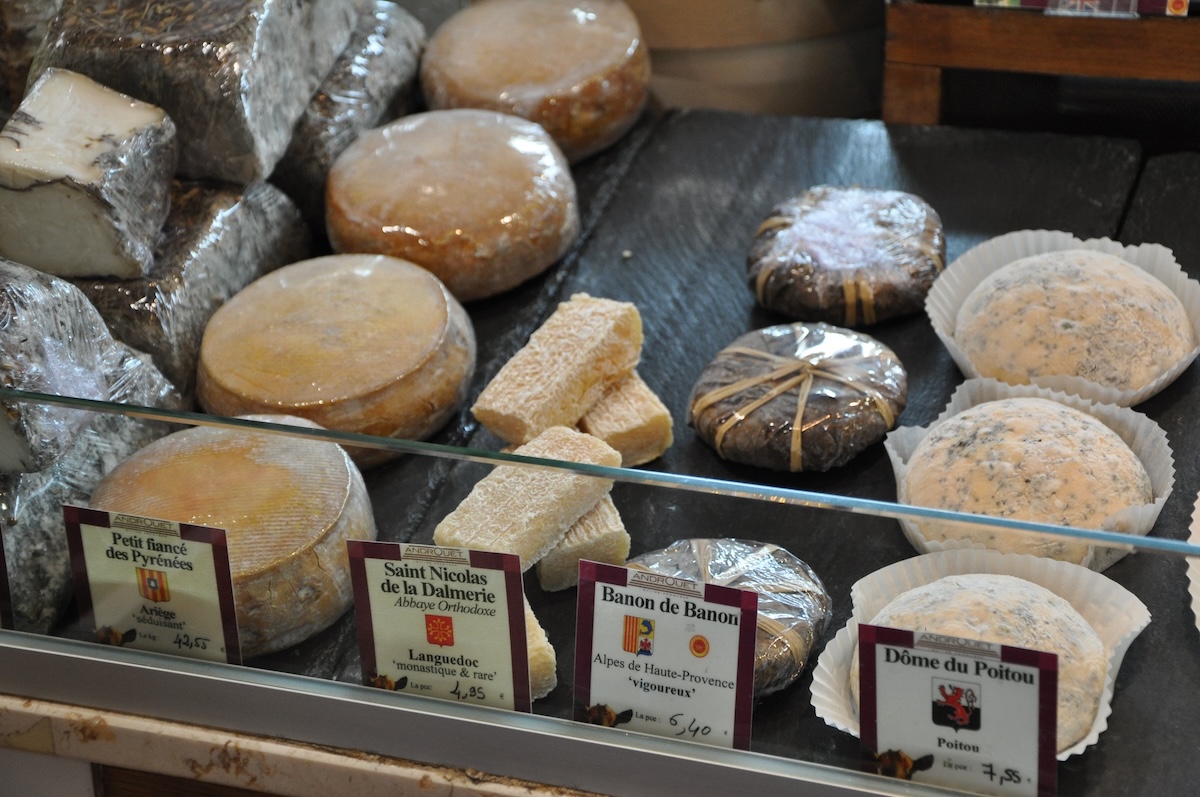
The assumption is generally that you’re eating stuff right away, so let your vendors know if that’s not the case, or if you intend to travel with your goods. Cheese, for example, can often be vacuum-sealed (sous-vide) to help keep it fresh in transit. If we’re being honest, though, you’ll probably want to dig into that glorious French cheese ASAP.
6. Be Patient
It’s important to be patient, particularly if you head to the market later on in the day. The market is a social event just as much as a commercial one.
Regulars have relationships with the vendors, and this is their weekly check in, so be prepared to wait while they catch up. If you are in town for awhile, take the time to visit the same vendors and develop relationships. It will serve you well.
7. Know Your Kilos
Items will most frequently be priced by the piece (pièce) or by kilo. A kilo is 2.2 pounds. Occasionally, things like truffled cheese are priced by the gram instead of the more common kilo, and you could end up spending a small fortune if you’re not careful.
Even if something is charged by weight, you don’t have to order by weight. Feel free to use your hands to indicate the size of what you’d like or to request a specific number of slices (tranches).

8. Ask for Help
The vendors are experts, and often aren’t shy about offering their advice. They’re usually happy to suggest which apples are better for baking than eating, or how long to roast the lamb.
9. Line Up Strategically
The French are notoriously bad at queuing, so stay alert and don’t be afraid to assert yourself. Watch out for elbows or getting your foot run over by a nana trolley.
The longest line is often the best one. Assume that you’ll just figure it out what the fuss is about by the time it’s your turn.

10. Pay Attention to Produce Signage
Terroir, the idea that where your food has been grown is intrinsically linked to flavor, is the backbone of the French food system. Origin is everything, and everything will be labeled accordingly. If it’s from another country, it’ll say which one. If it’s from France, it’ll often list the region or town.
Biologique or bio means certified organic. Produce will be categorized into extra (top, restaurant quality), catégorie I (bonne)—excellent quality—or catégorie II (qualité), which is good with a few defects but still usable/delicious.
11. Know Your Vendor
Most of the stalls in the markets are not actually farmers themselves, but resellers who purchase their goods at Rungis, a massive wholesale market just outside Paris. There’s no stigma against resellers. They are excellent quality and will have their own specialties.
Maraîchers, farmers who sell their own goods, are harder to come by. Their stalls might look slightly more rustic.

12. Carry Cash
Bring small bills and coins. Many vendors will have credit card machines, but they may have a minimum, not accept a foreign credit card, or just find it more inconvenient in the weekend crush of humans. Make your vendor’s life easier and pay in cash—they’ll be grateful for it!
13. Samples Are Never Expected, But Always Appreciated
Certain vendors will happily offer them up, but don’t expect it across the board.
14. Avoid Mondays
Check out the city’s market website to find one close to where you’re staying (or check out our guide to the best 5 food markets in Paris). Plan ahead for Mondays, as there are no markets open then. Otherwise, you can find one just about any day of the week reasonably close by.

15. Learn a Few French Words
A little French will go a long way in the market. Make the effort, and your market experience will be that much better.
- Mûr – ripe
- Pour aujourd’hui – for today
- Pour demain – for tomorrow
- Pour le weekend – for the weekend
- Sous-vide – vacuum-sealed
- Bien-cuit – well-cooked
- La viande – meat
- Le poisson – fish
- L’agneau – lamb
- Le poulet – chicken
- Les oeufs – eggs
- Fruits – fruit
- Legumes – vegetables
- Un petit peu plus – a little bit more
- Moins – less
- Un sac plastique – plastic bag
- Je voudrais – I would like
- Ça fait combien? – How much does it cost?
- Une poignée – a handful
- Une barquette – the little basket or container that fruit or veg might come in
- Une tranche – a slice
- Une douzaine – a dozen
- Biologique – organic

Experience an Authentic Parisian Market for Yourself
We’d love to join you! On our Paris Ultimate Food Tour, you’ll step into a bustling market in the heart of Le Marais, say bonjour to some of our friends who proudly run their stalls, and try some of the goods for yourself. We can’t wait to be part of your Paris foodie adventure!

Featured Review: Ultimate Paris Food Tour
⭐⭐⭐⭐⭐ “Anne Lorraine was fantastic! She had so much energy and knowledge and the food was better quality than we ever expected. We learned so much and now are ready to explore the Paris food scene on our own. 10/10 recommend DO THIS TOUR FIRST and you will eat good the rest of your stay in Paris!”
– christifav
Paris Food Markets FAQs
What time do Paris food markets open and close?
Most open-air food markets operate in the morning, typically opening between 7-8 am and closing around 1 or 2 pm. Some larger neighborhood markets reopen or stay open later, but for the freshest selection and the liveliest atmosphere, it’s best to arrive well before noon. Always check the market’s schedule before you go, as opening days and hours vary by neighborhood.
Can I bring food home with me from a Paris food market?
Yes, but be aware of your country’s customs regulations before purchasing fresh food to bring home. Many travelers instead choose shelf-stable specialties like mustard, jams, honey, chocolate, spices, or vacuum-sealed products.
Do I need to speak French to shop at a Paris market?
Not fluently! Learning a few basic phrases—such as “Bonjour,” “Je voudrais…” (“I would like…”), “Merci,” and “Au revoir”—will go a long way. Many vendors know some English, but making the effort to greet them in French is considered good etiquette and often leads to a better interaction.
Are Paris food markets open year-round?
Yes, most neighborhood markets operate throughout the year, with vendors changing their offerings to match the seasons. Visiting in different months means you’ll discover different specialties, from spring asparagus and summer berries to autumn mushrooms and winter oysters, making every market visit a little different..